Saturday, August 1, 2009

Fairy Smoke: The Worlds of Monotropa uniflora

Photo by Darcey Blue French

Ghost Plant. Indian Pipe. Fairy Smoke.

The names suggest the strange, otherworldly nature of Monotropa uniflora, the white, non-chlorophyl producing parasitic plant that grows in the damp of the forest floor.

I began to know Monotropa this June on a walk down the River Road. Finding the ghostly plant by the side of the road, I got down on my knees to inspect it more closely. The flowers smelled of pickling vinegar. The stem seemed a tunnel to the world beneath the forest floor.

I felt my breath slow and deepen and a cool, mild euphoria come in through my chest and move up and down along my spine, radiating throughout my body. I smelled and felt rich, moist forest soils.

The plant told me to put one of his flowers in my mouth. I chewed on it for several minutes, and felt a tingling in my mouth. I spit it out and stood up slowly.

I was very clearly in another state of consciousness. I was acutely aware of the forest around me -- especially of the vast interwoven network of roots beneath the surface, and the communication across them.

I began walking down the road, deeply grateful for the worlds Monotropa was opening to me.

About fifteen minutes later I became very hot and began sweating profusely.

It occurred to me that I knew next to nothing about the flowers of this plant and that I might have poisioned myself.

And I began to imagine my death I knew that I had a four or five mile walk home down roads that don't see much traffic. I imagined collapsing and rolling down the bank and then rotting into the forest floor, becoming food for the life around me. And I felt completely at peace with that possibility.

And at the same time, I was acutely aware of work I wanted to do in the world, of experiences I wanted to have. So I began negotiating with Monotropa, saying that I wanted to go back into the world to be a voice for the forest. And Monotropa listened.

I rounded the final bend past the pond where Jonathan was tending a fire. I told him "I either just ate a potent psychoactive plant or a potent toxin." He knew me well enough to just nod.

Back up at the house, still feeling very much under the influence of the plant, I began a frantic google search for information about Monotropa toxicity.

Was I poisoned?

There is a warning of unknown origin repeated verbatim in many articles about Monotropa online -- "Safety undetermined; possibly toxic -- contains several glycosides."

However, I've been unable to come across any documented cases of human or animal poisonings from ingesting Monotropa -- except a bizzarre nineteenth century account of a woman getting sick from eating honey made by bees that pollenated Monotropa flowers.

As best I can tell the concerns come from the known toxicity of Azaleas and Rhodedendrons, Monotropa's closests relatives. And while this suggests a certain prudence is in order, it seems a bit much to extrapolate that Monotropa is cardiotoxic based on its taxonomy.

The one actual account of eating the flowers that I eventually came across was quite different from my own experience. Ryan Drum wrote simply "I ate an ounce or more of the young flowers and stalks and was slightly nauseous. I did not want to eat it again. "

Plants do not always work the same way for different people in different places in different times. I think that under certain circumstances, Monotropa can become potently psychotropic.

Within a few hours of being placed in 100 proof vodka, Monotropa turns the clear liquid a deep, almost black blue, strangely reminiscent of the color of a bruised Psyolcibe cubenis mushroom -- could this be a signature for entheogenic actions? Ryan Drum notes that "consumption of 15 ml or more of Monotropa tincture can bring deep sleep and ultra vivid dreams, often bizarre, frequently erotic."

My intuition is that Monotropa was moving me through a particular intitiation -- facing death and embracing its beauty. No healer can promote life without an intimate relationship with death.

I believe the plant has played this role for many in North America over the millennia. And the need for this role is one of the reasons Monotropa has become so abundant this summer.
____________________________________________________________________

There are other gifts Monotropa is here to bring us as well.

David Winston notes that Monotropa uniflora is a diaphoretic especially well suited to fevers with pain (and from my experience of sweating profusely shortly after eating the flowers it seems it is an especially powerful diaphoretic) -- this suggests its use in illnesses from malaria to West Nile virus to serious influenza infections. He also notes its antispasmodic and anticonvulsant properties.

But it is the anodyne and sedative properties Winston notes are among its most unique and amazing gifts.

The plant itself resembles a spinal cord and a brain stem, suggesting its affinify for the nervous system.

Tommy Priester describes Monotropa as a plant that takes your pain and puts it beside you. You remain aware of the pain but you no longer feel it. He speaks of a friend able to calmly watch surgery performed on his own foot after taking Monotropa tincture.

I speculate that Monotropa may act on the sensory gating channels, preventing the sensation of pain from reaching the neocortex while still allowing non-sensory pain signals to reach the brain.

Monotropa also shows great potential as a sedative for people having dissociative or psychotic episodes. Ryan Drum tells a story of using the plant for this purpose:

"A very agitated distraught large young man came by at dawn one day. He was gesticulating wildly, speaking very loudly, rapidly, angrily, rather disjointedly and a bit menacing. ALIENS WERE IMPLICATED, threats, large weapons, revenge, cleaning up the place (of undesirable neighbors) plus grossly inflated assumptions of personal grandeur. Charming.

"He claimed not to have slept for at least three days and nights and that his head was boiling with unsolicited thoughts and images. His history included perennial meanness and medicated behaviour. I diagnosed sleep deprivation, dehydration, too much recreational medication, and no real food for many days, extreme anger, social isolation, and a desperate attempt to stop his delirium. Finally, during the first break in his rapid rambling 3-hr monologue, I asked him what he wanted from me. Besides potential sanctuary, he wanted herbal help to sleep and start thinking clearly. At that time I did not know he had been menacing neighbors and family. I told him I would give him a potion to do both, the strongest medicine I had. If it did not work in 4 hours or less, it wouldn't work for him. I gave him 2 ounces of a mixed tincture of Monotropa and Sea Blush Roots (an abundant annual marine valerian, Plectritis congesta) which he drank at once. Shortly after he left me, he napped, made circumstantial peace with his family, and voluntarily boarded the law enforcement plane for his involuntary journey to a psychiatric hospital for evaluation"

This could conceivably be the result of action on the senory gating channels or the neocortex as well. People having psychotic episodes often project meaning onto everything around them, possibly indicating an overly stimulated neocortex. Reducing the sensory stimuli flowing to the neocortex may help to sedate someone in this kind of situation. Anemone pulsitilla and Anemone tuberosa seem to work in this way.

____________________________________________________________________

Over the past few months, a half dozen other herbalists have told me they have been discovering a new fascination with Monotropa. And this year this frequently rare plant seems more abundant than ever.

I don't believe that Gaia makes mistakes.

The rains this summer offer a partial explanation.

But I am also noticing that a lot of plants appear a short while before their medicine is greatly needed.

I don't know if there are energetic patterns that signal the coming of mass trauma -- but something tells me that the forest is bringing us this plant right now because we will need its medicine soon. We would do well to begin exploring the medicine of Monotropa more deeply.

Wednesday, July 29, 2009

Green Man Botanicals -- Tinctures and Flower Essences for Sale

The forests and fields of Maine have blessed me with great abundance this year -- and I am offering the first in my line of ethically wildgathered Tinctures and Flower Essences for sale.

Watch later this summer for more Tinctures and Flower Essences from plants gathered on my journeys into the wild or lovingly grown at Nezinscot Farm, a biodynamic (and certified organic) farm in Turner, Maine.

I currently have the following tinctures and flower essences available for sale -- $10 for 1 oz, $8 for 1/2 oz, $5 shipping per order. Ask about prices and availability for larger amounts. To order, e-mail me at seandonahuepoet@gmail.com. I accept PayPal, checks, money orders, and cash -- and am also very open to barter.

Please note that none of these products are intended to diagnose, treat, or cure any medical condition. Notes on the uses of these plants and lichens are strictly ethnobotanical in nature.

TINCTURES

Usnea (Usnea barbata) -- Commonly known as "Old Man's Beard," this lichen was traditionally used as a wound dressing to prevent infection. More recently, herbalists have found this lichen very effective in supporting the immune system and in helping the body fight off bacterial infections, especially in the lungs. Whole lichen inctured in 100 proof vodka.

Oxeye Daisy (Chrysanthemum Leucanthemum) -- The Eclectic Physicians of the nineteenth century classified this plant as tonic, diuretic, and antispasmodic. The 1898 edition of King's American Dispensary suggested its use for "whooping cough, asthma, and nervous excitability." Some contemporary practitioners have noted its affinity for the upper respiratory system. Aerial parts tinctured in 80 proof brandy.

Yarrow (Achillea millefolium) Glycerite -- Yarrow was traditionally used as a plant of divination. This preparation was made in the spirit of the plant's magical uses. Flowers and first year leaves in vegetable glycerin.

Red Clover (Trifolium pratense) Elixir -- Traditionally used to nourish pregnant women and lactating mothers, smooth the transition into menopause and andropause, promote fertility, and support the lymphatic system, among dozens of other uses. Flowers in a blend of vegetable glycerin and brandy.

Coming soon: Self-Heal Tincture and Forsythia Flower Tincture.


FLOWER ESSENCES

All essences are Stock Essences.

Eastern Skunk Cabbage (Symplocarpus foetidus) -- For those who walk between worlds.

Trillium (Trillium Erectum) -- An ally in giving birth to the self.

Pink Lady's Slipper (Cypripedium acaule) -- Cradles and supports the heart, allowing it to open to healing love and healing eros, human, wild, and divine.

Self-Heal (Prunella Vulgaris) -- Restores faith in our ability to heal ourselves.

Coming Soon: Black Cohosh and Joe Pye Weed

Tuesday, July 7, 2009

Lady Slipper and Solider's Heart


(Photo: Wikimedia Commons, photographer unknown)


Stephen Harrod Buhner describes the medicine of Lady Slipper as being like two loving hands cradling the heart.


In the wake of the Civil War, the shattered hearts of soldiers cried out for the Lady Slipper's medicine, and she was gathered almost to the point of extinction.


Plant medicines produce a direct and immediate impact in the body to alleviate suffering. At the same time they work to help the body remember the way back to health. This deep and often subtle healing happens best when space is opened for the plant to work deeply inside someone over time, penetrating further into the consciousness and the heart field.

These forms of healing are, of course, inextricably linked. But in a culture that has forgotten that the plants are our ancestors and teachers, the living medicine of the plants we use is often forgotten and ignored. Too often plant medicines are applied in a mechanistic way to create a specific result in the body. The medicine is still the medicine -- but when we don't give it space and time to do its work, and we don't engage the plant, much is lost.

I imagine the shape of the Lady Slipper's blossom -- a heart open in the center shielded by wing-like petals -- and I imagine the way she could teach a heart forced shut by the brutality of war to begin to allow healing in again. And, knowing enough Veterans who left pieces of themselves on distant battle fields, I also know something of the incredible patience and strength that opening takes.

Did the doctors treating "Soldier's Heart" in the wake of the Civil War bring their patients to the woods to be with the plants that would become their medicine? More likely the tinctured root was administered to a patient who was taught little about its source. In the parlance of the day the plant was known as "American Valerian," used primarily as a sedative. Plants are generous, using their bodies to create the medicines that will restore the imbalances in the ecosystem they perceive through the chemical and electromagnetic information they take in from the world around them -- including the imbalances in the bodies of the humans who share their habitat. But the imbalances created in our culture are too big for the plants to correct through chemistry alone.

There wasn't enough Lady Slipper in all of North America to heal all the pain and terror and loss the people here experienced as a result of the Civil War.


And at the same time a single Lady Slipper could have taught the culture all it needed to know about how to reshape itself in ways that would give hearts the space they needed to heal and open again like pink orchids in the understory of a shady forest.

Even more than we need plants as physical medicines today, we need them as teachers. And to know them as teachers, we need to come to know them in the wild.
Wildness is a fundamental part of their medicine. And wildness itself is the best medicine for the diseases of civilization -- violence, alienation, stress, numbness, grief, and rage. Former Green Beret Doug Peacock has written and spoken eloquently about how time with Grizzly Bears in the wilderness of the Rocky Mountains saved his life when he came back from Vietnam angry and devastated and wanting nothing to do with the culture that sent him to war. Those of us living in that culutre would do reflect on the more subtle injuries we sustain from accepting brutality as an inevitable part of life.

In a culture at war with the Earth and with the wildness inside its own people, we all suffer from a variant of Soldier's Heart -- it is only diagnosed in those who show the most severe symptoms -- Veterans of war and survivors of torture and physical and sexual abuse. But in their pain we see our own amplified ten thousand fold and mirrored back. I am not speaking metaphorically -- nobody who has been exposed to the ravages of Post Traumatic Stress Disorder (as Soldier's Heart is now called) even in passing could ever view such a profound psychological injury as a metaphor. Rather I am speaking of the fact that in the most violent culture in history, trauma is universalized, and diagnosis of Post Traumatic Stress is a matter of differentiating the most extreme cases from the mental and emotional health state of the general population.

Psychotherapist Chellis Glendinning describes the traumatic break that all of us have experience as a result of the dissonence between what our bodies know and what our culture telss us and makes us experience -- a break far more subtle but chillingly similar to that experienced by those who survive war, rape, and abuse:
"And as goes the outer, so goes the inner. The psyche that, by all accounts, had been a worthy reflection of the unity of seasons, wind and waters, soil and rock, stars, plant and animal life was shattered and scattered too. I see this breakage as the traumatic response – the splitting and sending into unconsciousness those experiences the organism is not designed to process, the seat-of-the-pants clawing for function and meaning in what is left of the conscious mind. And so the onslaught that appears to us as the unending march of harsher forms of technological systems, the grasping for control by global corporations, the splitting of community into those who have it all and those who have nothing -- this is reflected in a parallel inner onslaught that manifests as the march of abuse, a grasping for rationalization, and the splitting of psyche into denial and numbing on one side and unspeakable suffering on the other."
All of this has its physical consequences as well. Pam Montgomery writes in Plant Spirit Healing that:
"Heart disease is the single leading cause of death in the United States, claiming more lives than the combined next four causes of mortality. [ . . . ] According to heart surgeon, Dr. Philip Bhark, only half of heart attacks are caused by known risk factors like tobacco and obesity. What then is causeing such massive heart disease? Could it be that we are dying from broken hearts? And if so, what is causing them to break? The heart is made up of 10 billion cells that synchroinize in electical wavelike patterns. Dr. Bhark says that more than half of heart-related deaths are from sudden cardiac death, which is the abrupt disruption of electrical patterns in the heart. It seems that high levels of stress interfere with the electrical rhythm of the heart. Stress is not just a fight or flight reaction. It can also result from tension created in the body while having to process varying degrees of ever-present external challenges, then disrupting our inner connection with the laws of nature and even affect the synchronization of our natural rhythms. Additional tension can also result from the interference of manmade electrical fields. The natural wavelike pattern found in nature is one cycle per second, which is the same rhythm as the heart's. Could it be that the loss of connection to the natural world, created by modern life, is the original wound and this primary seperation is causing our hearts to break?"
(And could it be that war, on the collective level, and violent crime, on the individual level, are the way broken hearts replay their wounding, projecting it outward -- the result of being so deeply wounded that we come to believe woundedness and wounding are our fundamental nature?)

As an herbalist, I treat stress-related disorders with adaptogens and nervines -- much as Civil War doctors used the tinctured root of Lady Slipper. These medicines are important -- I have seen them help people who were prisoners of anxiety reclaim their lives.

But walking the forests of Maine where the Lady Slippers are coming back in greater and greater numbers, I remember that the most important work I do involves connecting people with the living Earth that is the source of their healing.

That's the medicine that makes hearts whole again.

Wednesday, July 1, 2009

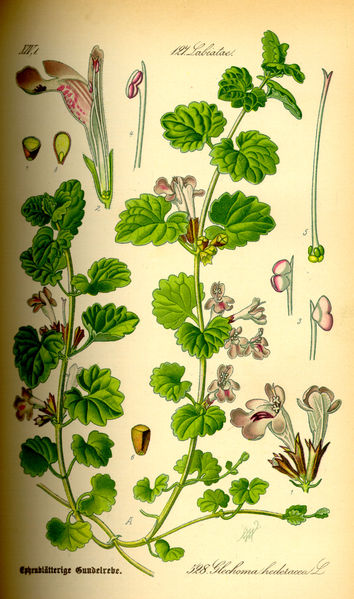
Ground Ivy


Image from Wikipedia, source: Prof. Dr. Otto Wilhelm Thomé Flora von Deutschland, Österreich und der Schweiz 1885, Gera, Germany

[This post is my contribution to the Blog Party being hosted by an amazing herbalist, Darcey Blue French, at http://desertmedicinewoman.blogspot.com/ on the theme of "Weeds of Summer that you love to love, that others love to hate...."]

Weeds are the outlaws of the plant world -- plants that escape cultivation and resist eradication, slipping in where they aren't wanted, subverting the gardener's idea of control. Medicinal allies of the common people, dismissed by the medical profession throughout history (think of the plants whose Latin binomials contain the word vulgaris.)

Neither of Ground Ivy's Latin names (Glechoma Hederacea or Nepeta Glechoma) contain the word vulgaris, but Ground Ivy otherwise fits the definition well. According to a website maintained by Purdue University's School of agriculture "Ground ivy is difficult to control and it is a problem in 31% of lawns maintained professionally in Indiana." The State of Connecticut officially made Ground Ivy an outlaw, banning its cultivation in 2004. They were, of course, a bit late -- the tiny creeping mint came over with the first colonists who used it to make medicine and ale.

(Alehoof was a common name for the plant a few hundred years ago, reflecting its use as a bitter in beermaking prior to the standardization of beer composition that began with the German Beer Purity Law of 1516, a law designed in large part to end the production and consumption of psychotropic and aphrodesiac beers. See Stephen Harrod Buhner's Sacred and Healing Herbal Beers for more on this history.)

Ground Ivy was popular in British and American folk medicine well into the nineteenth century. Maude Grieve wrote:
"From early days, Ground Ivy has been endowed with singular curative virtues, and is one of the most popular remedies for coughs and nervous headaches. It has even been extolled before all other vegetable medicines for the cure of consumption.

"An excellent cooling beverage, known in the country as Gill Tea, is made from this plant, 1 OZ. of the herb being infused with a pint of boiling water, sweetened with honey, sugar or liquorice, and drunk when cool in wineglassful doses, three or four times a day. This used to be a favourite remedy with the poor for coughs of long standing, being much used in consumption. Ground Ivy was at one time one of the cries of London for making a tea to purify the blood. It is a wholesome drink and is still considered serviceable in pectoral complaints and in cases of weakness of the digestive organs, being stimulating and tonic, though it has long been discarded from the Materia Medica as an official plant, in favour of others of greater certainty of action. As a medicine useful in pulmonary complaints, where a tonic for the kidneys is required, it would appear to possess peculiar suitability, and is well adapted to all kidney complaints"

Despite (or more likely because of) its popularity, Ground Ivy was not well regarded by physicians of the late nineteenth and early twentieth centuries. In 1869, William Cook wrote that "the marvelous repute it once enjoyed in England, has very properly faded away." The 1918 edition of the Dispensatory of the United States of America said:
"The herb was formerly official, and still enjoys some credit as a domestic remedy. It has a peculiar, disagreeable odor, and a bitterish, somewhat aromatic taste, and imparts its properties to boiling water. It is very prone to have galls developed on it, and to be infested with certain fungi."
But in recent years, the herb has made its way back into medicine, and even into commerce.

I was introduced to Ground Ivy by Madelon Hope of the Boston School of Herbal Studies who spoke of the plant's affinity for the upper respiratory system I gathered the flowers this spring and tinctured them in 80 proof Vodka. The tincture was ready just as I had a number of clients come to me complaining of head colds marked by severe sinus congestion, slight throat irritation and inflamation, and minor swelling of the lymph nodes in the throat. I used Ground Ivy in a formula with Yarrow and Elder Flowers and Berries at a dosage of 30-60 drops every 4 hours depending on body weight, and most clients reported relief from all symptoms by the end of the first day. I have found Ground Ivy very effective in relieving my own sinus congestion and inflamation.

David Winston speaks of several uses I have not yet explored in his section on the plant in his American Extra Pharmacoepia, including:
  • clearing toxic heat from the liver and gallbladder and promoting bile excretion
  • getting the blood moving and reducing swelling in traumatic injuries
  • increasing lead excretion in urine
Winston also notes that Ground Ivy has antiviral qualities -- which supports the emerging sense among many herbalists that rapidly spreading plants tend to be effective in treating rapidly spreading diseases.

This little outlaw who grows close to the ground and quickly overtakes yards and pastures is fast becoming one of my favorite medicinal plants.


Monday, June 29, 2009

Blood

"Your blood flowed before your heart was formed." -- Stephen Harrod Buhner

Your blood
began moving
before your heart
was formed,

humming and buzzing
through your veins

until you heard
a rhythm
through the waters
of the womb

calling you
like a humpback whale
singing
across oceans

and muscle
and nerve
came together
to form a magnetic drum

that set the iron
spiraling
in an wild dervish dance.

Monday, June 22, 2009

Joy on Earth: Yarrow Divin-ation

"Sing, feast, dance, make music and love, all in My Presence, for Mine is the ecstasy of the spirit and Mine also is joy on earth."

-- The Charge of the Goddess

Three days of dancing barefoot in the rain on Harry's Hill and practicing the seat-of-the-pants art of holistic field medicine brought an undeniable ecstasy.

But a few days in the human world always leaves me hungry for time alone with wild plants.

So this afternoon, when the rain let up I put on my lined flannel shirt and set off to gather Yarrow.

Yarrow is one of the plants I use most frequently in treating clients. I love Yarrow's ability to help the body released trapped heat. I also love the way the plant has both analgesic and anti-spasmodic actions, making it a wonderful ally for those experiencing muscle cramps and spasms. Combined with the plant's ability to regulate the menstual flow, these qualities also make the Yarrow an excellent ally for women with menstrual cramps. And I frequently use Yarrow and Elder together to treat colds and flus.

But Yarrow fascinates me most as a psychotropic plant, bordering on the entheogenic. ("Entheogen" is an ethnobotanical term for plants that induce profound spiritual experiences, bringing out the divinity inherent in all things.) Maude Grieve noted in A Modern Herbal (the source of the illustration above) that Yarrow "was one of the herbs dedicated to the Evil One, in earlier days, being sometimes known as Devil's Nettle, Devil's Plaything, Bad Man's Plaything, and was used for divination in spells. "

These names were, of course, given to the plant by medieval and early modern Christians who were trying to seperate people from seeking out the direct experience of the wild divinity of the living Earth. Divination, after all, is also the process of revealing the presence of the divine in all things -- and the wilderness was the place where people traditionally went to align their human and divine natures. This posed an obvious threat to those who would insist that the consciousness of the divine could not be accessed without their intercession and that the presence of the divine could only be felt in their churches.

What was so dangerous to these people about Yarrow?

I got my first glimpse of the answer last summer during my vision quest in the Pemigiwassett wilderness. On the third day of fasting, a throbbing headache was keeping me from being fully present. Yarrow was the one analgesic herb I had in my pack, so I began taking it -- just a dropperful at first, but then several more over the course of the next two hours. I felt my senses heighten and warmth radiating throughout my body. When I stumbled from my tent to the edge of my circle of stones, the Usnea growing on a fallen Hemlock branch became illuminated and began to speak to me.

To be sure, fasting, solitude, and the magic of the Usnea himself played big roles in shaping that moment -- but Yarrow was an important part of the mix. And the presence of a thujone, hypnot cannabanoid compound in Yarrow provides a partial biochemical explanation of what I experienced -- but

Today, as I gathered Yarrow, I was tasting the blossoms and some of the young leaves to try to find the patches with the strongest medicine. I felt that familar warmth and heightening of my senses. Though it was cloudy and it was late afternoon everything brightened.

I continued up the dirt road where we live toward the old Lincoln place. I noticed a fresh bundle of Yarrow flowers, recently picked, on the ground. But nobody has been in that place this summer and no cars came up or down the road today and my housemates had been inside all day as had Tom and Joanna up the road. I gathered them up and put them in my jar -- exactly enough to fill it the rest of the way to the top.

I turned around and the wind brought the scent of roses. Right across from me were blooming Prickly Roses that I had never seen in that place before.-- Rosa acicularis, a rose common to disturbed areas in boreal forests.

The scent alone opened my heart wide, and I felt at the edge of tears of gratitude and joy.

I looked up and a hawk circled overhead.

The porous nature of the boundaries the self became clear. Rose mind, Hawk mind, Yarrow mind, seeped into my own consciousness.

Something about Yarrow seems to facilitate the operation of the heart as an organ of perception -- or to drop the consciousness into the heart where the heart's perception plays a larger role in the self's processing of reality. Maybe this is the nature of divin-ation, the art of opening the heart wide enough to fine tune its sense of the electromagnetic flow around it, giving the mind access to information it would not normally be able to access. In that state, the unity and interconnectedness of living things becomes real -- and we have access to a web of information larger than ourselves, an ecological brain we might call Gaia.

And in the fractal reality that opens us to, all beings feel pleasure in our pleasure, and we become joy on Earth. At once human, wild, and divine.

Tuesday, June 9, 2009

Mutations and Opportunities

Donald McNeil Jr. wrote about potential mutations of the H1N1 "Swine Flu" virus in today's New York Times. After explaining the highly unlikely process by which the virus could become considerably more lethal, McNeil noted that:

A much more likely change, scientists have said, is that the H1N1 swine flu will become resistant to the antiviral drug Tamiflu. A gene for Tamiflu resistance is now almost universal in seasonal H1N1 flus.

If that happens, the world’s Tamiflu stockpiles will be all but worthless, and doctors may have to switch to Relenza, which is a powder used with an inhaler, which makes it more expensive and harder to take.

Depending on the mutation, older antiviral drugs like rimantidine may be useful, but so much resistance to them developed in seasonal flu that they were largely abandoned a few years ago.

This is one of the biggest problems with modern, synthetic pharmaceuticals. As complex as they may seem to us, they are far simpler than the chemicals produced by living things -- be they viruses, bacteria, plants, animals, or humans. So it doesn't take long for a virus or a bacteria to crack the code and develop an effective technique to resist our pharmaceuticals. But rather than seeking a different approach, most of the medical community looks to new generations of pharmaceuticals to combat viruses and bacteria that resist existing drugs.

Modern pharmaceuticals do have the advantage of causing quick and dramatic changes in the body that can buy time for healing in life threatening situations. But those advantages are lost completely when the drugs are used so widely that resistance to them becomes widespread.

Herbal medicines have the advantage of more complex chemistries than synthetic pharmaceuticals. As James Duke writes in the foreword to Stephen Buhner' Herbal Antibiotics:

It is easy for a rapidly reproducing bug to outwit (or out-evolve) a single compound by learning how to break it down or even to use it in its own metabolism, but not so easy to outwit the complex compounds found in herbs. Scientists are recognizing this fact and developing more complex compounds such as the AIDS cocktail and multiple chemotherapies for cancer. The same super-scientists who downplay the herbalists' claims of synergies that account for the effectiveness of particular herbs and herbal formulas, are now resorting to synergies of three or four compounds in their pharmaceutical formulas.

It is certainly easier to demonstrate how two compounds can work together synergistically than it is to figure out how 200 or 2000 different compounds (and more, as are present in all herbs) can work synergistically. So the scientific community will be reluctant to consider the remarkable synergistic suites of compounds that have evolved naturally in plants. But we really cannot afford to ignore these. For nature favors synergies among beneficial, plant-protective compounds within a plant species (with antibacterial, antifeedant, antifungal, antiviral, and insecticidal properties,) and selects against antagonisms.

What's more, plants are constantly modifying their chemistries in response to environmental changes -- the same changes our bodies are experiencing -- while the chemistry of synthetic pharmaceuticals remains fixed.

But speaking in these terms, we are still missing something important.

Influenza, or any other diesease, isn't caused simply by the presence of a virus. Rather it is the result of a virus opportunistically multiplying out of control in a body whose natural defenses are already weakened and whose internal ecology is already out of balance. The virus is necessary for the disease to occur, but not sufficient.

Because the presence of the virus is the one common recurring element in the bodies of different people presenting similar symptoms, modern medicine tends to focus on eliminating the virus. In so doing, it tends to ignore the different factors that made each person susceptible to infection, and the differences between them and the people who are exposed to the virus but don't get sick.

(Think, for example, about the fact that the majority of sexually active adult women who have had multiple partners have been exposed to strains of the Human Papiloma Virus linked to genital warts and/or cervical cancer, but only a small percentage of the women exposed to HPV ever develop these diseases.)

Traditional herbalists and other holistic healers tend to look at these differences in detail, and employ therapeutic protocols that support the body's own ability to fight off infection and restore healthy function to all of the body's systems. In treating severe acute infections such healers will sometimes rely on high doses of certain "anti-viral" or "anti-bacterial" or "anti-fungal" herbs or even synthetic pharmaceuticals to address an emergent situation -- but these medicines serve primarily to open the way for other medicines to do the subtler work of helping the body heal itself. As Matthew Wood writes in The Practice of Traditional Western Herbalism:

Biomedicine is constructed upon a materialistic interpretation of nature, which looks to its molecular structure as a guide. Holistic medicine is founded on the concept and experience that the organism is a functional unit or whole under the guiding hand of an intelligent, self-regulating, self-correcting guiding force or energy. Since Nature in the organism is self-maintaining and self-healing, holistic medicine is further based upon the assumption that the organism can be cured, that is, returned from an unbalanced state to one of balance or homeostasis.

The molecular level is, of course, very real. But it is also a level of reality whose existence we have only recently discovered. And we are tinkering there before we understand its logic, its flow, and its guiding principles.

It is the height arrogance to think that we can understand whats happening in our cells at a molecular level so well that we can afford to completely ignore the big picture of what is happening in our bodies, or that our creations can surpass the genius of the medicines that plants have developed over billions of years.

The proliferation of drug resistant viruses and bacteria provides us with an opportunity to reflect on and correct that arrogance while choosing another path -- one that uses synthetic pharmaceuticals sparingly and as a last resort, while relying primarily on the insights of the 150,000 year old science of herbal medicine to restore and maintain health. In the process, we just may remember that we are part of a living planet -- something essential to our prospects for survival.